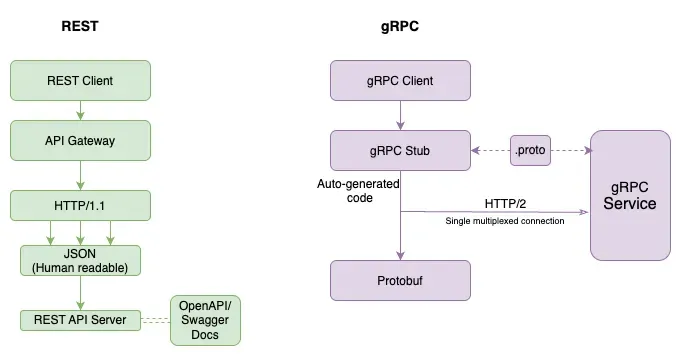
Figure 1: REST vs gRPC flow.
Introduction: What’s the Problem?
If you’ve been building microservices for any length of time, you’re likely familiar with REST APIs. They’re ubiquitous, well-documented, and get the job done. But as your system grows from a handful of services to dozens or even hundreds, pain points emerge. Service-to-service communication becomes increasingly complex, latency adds up, API contracts become fuzzy, and documentation falls behind implementation.
The problem is that REST was designed primarily for public-facing APIs where human readability and simplicity were prioritized over performance and strict contracts. For internal microservices talking to each other at high frequency, we need something more efficient, type-safe, and built for machine-to-machine communication. Enter gRPC.
What is gRPC (and Protocol Buffers)?
gRPC is an open-source Remote Procedure Call (RPC) framework initially developed by Google. Unlike REST, which is centered around resources and HTTP verbs, gRPC is built around the idea of defining services that specify methods that can be called remotely with their parameters and return types.
At its core, gRPC uses Protocol Buffers (protobuf) as its interface definition language. Protocol Buffers allow you to define your service contracts and message structures in .proto files:
service UserService {
  rpc GetUser(UserRequest) returns (UserResponse);
  rpc ListUsers(ListUsersRequest) returns (ListUsersResponse);
}
These .proto files are then compiled into client and server code in your language of choice. gRPC supports multiple programming languages including Java, Go, Python, Node.js, and C#, making it perfect for polyglot microservice architectures.
The real magic is that gRPC uses HTTP/2 as its transport protocol, enabling features like bidirectional streaming, flow control, and multiplexing requests over a single connection.
Why gRPC over REST?
The benefits of gRPC over REST for internal microservices are substantial:
Performance: gRPC uses HTTP/2, which allows for multiple requests to be multiplexed over a single connection. It also employs Protocol Buffers for binary serialization rather than JSON, resulting in smaller payloads and faster processing.
Type Safety: With Protocol Buffers, you define your data structures and API contracts explicitly. This means no more guessing what fields an API expects or returns. Code is auto-generated from these definitions, eliminating an entire class of errors related to serialization and deserialization.
Built-in Code Generation: The gRPC toolchain generates client and server stubs automatically. You get strongly-typed client libraries without writing any boilerplate code. This not only saves development time but also ensures consistency across service boundaries.
Bidirectional Streaming: Unlike REST, which is fundamentally request-response, gRPC supports client, server, and bidirectional streaming. This enables more efficient communication patterns for use cases like real-time updates or processing large data sets.
Service Definition as Contract: The .proto files serve as a single source of truth for both client and server. This enforces API contracts and makes versioning more explicit, improving collaboration between teams.
Deadline/Timeout Propagation: gRPC has built-in support for setting deadlines on client requests, which propagate through the entire call chain. This helps prevent cascading failures when services are experiencing latency issues.
What’s it like using gRPC with Spring Boot?
Integrating gRPC with Spring Boot is surprisingly straightforward. Here’s a simplified look at how to create a Feature Flag Service that lets applications check if specific features should be enabled or disabled.
First, define your service contract in a .proto file:
syntax = "proto3";
package featureflags;

service FeatureFlagService {
  rpc GetFeatureFlag(FlagRequest) returns (FlagResponse);
}

message FlagRequest {
  string featureKey = 1;
  string serviceName = 2;
}

message FlagResponse {
  string featureKey = 1;
  bool enabled = 2;
}
Next, implement the service in Spring Boot:
// SERVER CODE
@GrpcService
public class FeatureFlagServiceImpl extends FeatureFlagServiceGrpc.FeatureFlagServiceImplBase {

    private final FeatureFlagRepository repository;

    @Autowired
    public FeatureFlagServiceImpl(FeatureFlagRepository repository) {
        this.repository = repository;
    }

    @Override
    public void getFeatureFlag(FlagRequest request, StreamObserver<FlagResponse> responseObserver) {
        // Get the requested feature flag from database or cache
        String key = request.getFeatureKey();
        boolean enabled = repository.isFeatureEnabled(key, request.getServiceName());

        // Build and send the response
        FlagResponse response = FlagResponse.newBuilder()
            .setFeatureKey(key)
            .setEnabled(enabled)
            .build();

        responseObserver.onNext(response);
        responseObserver.onCompleted();
    }
}
On the client side, another service can consume the feature flag service:
// CLIENT CODE
@Service
public class PaymentService {

    private final FeatureFlagServiceGrpc.FeatureFlagServiceBlockingStub featureFlagService;

    @Autowired
    public PaymentService(GrpcChannelFactory channelFactory) {
        // Connect to the feature flag service
        Channel channel = channelFactory.createChannel("feature-flag-service");
        this.featureFlagService = FeatureFlagServiceGrpc.newBlockingStub(channel);
    }

    public void processPayment(Payment payment) {
        // Check if new payment method is enabled
        boolean useNewPaymentMethod = isFeatureEnabled("new-payment-method");

        if (useNewPaymentMethod) {
            // Use new payment process
        } else {
            // Use old payment process
        }
    }

    private boolean isFeatureEnabled(String featureKey) {
        FlagRequest request = FlagRequest.newBuilder()
            .setFeatureKey(featureKey)
            .setServiceName("payment-service")
            .build();

        FlagResponse response = featureFlagService.getFeatureFlag(request);
        return response.getEnabled();
    }
}
That’s it! Notice how clean and type-safe the implementation is. The server knows exactly what data to expect in the request, and the client knows exactly what will be in the response. The code generator handles all the serialization/deserialization for you, and Spring Boot’s integration makes dependency injection work seamlessly with gRPC services.
When NOT to use gRPC?
While gRPC excels for internal microservice communication, it’s not always the right choice:
Browser-based applications: Browsers don’t natively support gRPC. While solutions like gRPC-Web exist, they add complexity and don’t support all gRPC features. For user-facing applications, REST or GraphQL are often more practical.
When human readability matters: The binary nature of Protocol Buffers makes debugging with standard tools harder. For public APIs where developers need to explore and understand the API without code generation, REST remains superior.
Legacy system integration: If you’re integrating with systems that already expect REST/JSON, the adaptation cost might outweigh the benefits.
Simple applications: For small applications with just a few services and modest performance requirements, the additional complexity of setting up and managing gRPC might not be justified by the benefits.
Wrap-Up: Why You Should Try It
If you’re building a microservices architecture where internal service-to-service communication is frequent and performance-critical, gRPC offers compelling advantages over REST. The combination of HTTP/2’s efficiency, Protocol Buffers’ strong typing, and code generation can dramatically improve both system performance and developer productivity.
Start small by migrating a couple of services that communicate frequently. The investment in learning gRPC pays dividends quickly through reduced latency, better type safety, and clearer service contracts. As your system grows in complexity, you’ll start appreciating the structured approach that gRPC enforces.
Remember, you don’t have to choose between gRPC and REST exclusively. Many successful architectures use gRPC for internal communication while maintaining REST APIs for external clients. It’s about picking the right tool for each communication pattern in your system.